Swipe It: Board Wooden Puzzle
- 4.6
- Rating
- 500.00K
- Installs
- Free
- Price
 Analysis by App-foxy
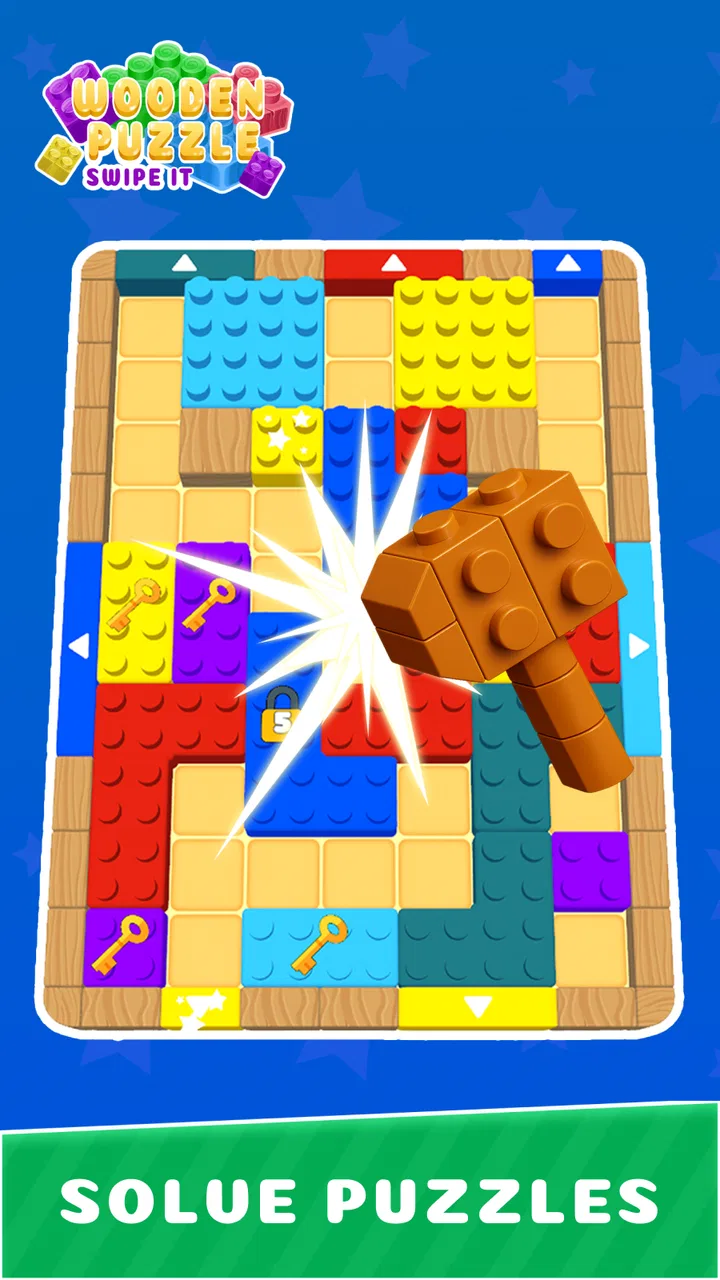
I spent my first sessions with Swipe It: Board Wooden Puzzle expecting a simple way to fill a few spare minutes, and that is exactly where this board game works best at the beginning. The idea is immediately readable: wooden pieces sit in a crowded layout, and I swipe them to clear a route. There is no complicated rulebook to study before playing. I could understand the objective within moments, then concentrate on the more interesting question: which move opens the board without creating a worse blockage somewhere else?
That simplicity gives the game a pleasant first-week appeal. It feels calmer than a timed arcade title and more tactile than many abstract logic games. The wooden presentation helps create a slower mood, while the sliding action keeps each puzzle active rather than passive. I found myself opening it during short breaks, waiting for an appointment, or winding down when I wanted something that used my attention without demanding a long commitment.
It is a free board puzzle game from INDOVIA, aimed at Everyone, and it runs on devices using Android 7.1 or later. The current version is 0.42, so I approached it as a compact puzzle experience rather than a large, feature-heavy game. That distinction matters: the attraction is the quality of the individual decisions, not a huge collection of unrelated activities.
You May Also Like

 Blood Strike: 2.5 Anniversary
Blood Strike’s Loadouts Turn Every Drop Into a Tactical Gamble
A close look at Blood Strike’s custom loadouts: how fast access to signature weapons reshapes its battle royale rhythm, rewards preparation, and narrows the gap between fights.

 Pandora - Music & Podcasts
Pandora’s Music Is Easy to Start, but Harder to Recover
Pandora’s strength is its low-effort path from a seed to a station. Its weak spot is how much confidence it asks you to place in connection, setup, and quiet recovery.

 8 Ball Pool
 Is Built on Rivalries, Rematches, and Routine
A close look at the rivalries, rematches, shared routines, and unanswered safety questions that turn a quick pool match into a persistent mobile community.

 Samsung Music
’s Quiet Strength Is Playing What You Already Own
Its reach comes less from spectacle than from dependable access to a personal library. That simplicity is both the app’s strongest retention engine and its ceiling.

 AccuWeather: Weather Radar
AccuWeather Review: A Quick, Clear Forecast for Everyday Decisions
For everyday plans, the best forecast is the one you can understand quickly. AccuWeather makes rain timing, radar, and local conditions easy to act on, with a few trade-offs.

 Hill Climb Racing
Why Hill Climb Racing Still Turns Crashes Into One More Run
A tiny car, a bumpy hill and one more upgrade: Hill Climb Racing keeps resurfacing because its simple chaos makes every near-miss feel personal.
More From Our News Desk
View All News


Why the first sessions feel so satisfying
The strongest part of the design is how quickly each board becomes a small planning exercise. I do not need to memorize a long sequence of rules. Instead, I look for the piece that is blocking the path, identify the spaces that might become useful, and decide whether a seemingly harmless swipe will trap another block. The best moments come when a board looks nearly frozen but one careful repositioning creates a chain of opportunities.
I especially liked that the game rewards restraint. In many casual puzzle apps, moving quickly is usually the safest approach because the challenge comes from speed. Here, I get more from pausing for a few seconds and reading the whole arrangement. That makes it suitable for players who enjoy logic puzzles but do not necessarily want the pressure of a countdown or a competitive leaderboard.
A useful habit is to treat the first few moves as reconnaissance rather than progress. I look at the open spaces and ask which direction each block can realistically travel. If I swipe the most obvious piece immediately, I may remove the visible obstruction while leaving the central area less flexible. Thinking one or two moves ahead is usually more valuable than chasing the first available opening.
Another practical tip is to avoid judging a move only by the distance a piece travels. A short slide can be strategically important if it frees a lane, while a longer movement may consume the exact space needed later. This is the sort of small trade-off that gives the game more substance than its short description suggests. The board is not just asking me to move objects; it is asking me to preserve options.
The game also fits naturally into interrupted play. If I have only a minute, I can make a few decisions and stop. If I have longer, I can continue examining the same puzzle until the solution becomes clear. That flexibility is a genuine advantage over board games that require a complete round or a fixed amount of concentration before they feel worthwhile.
A realistic everyday use
My most convincing use case was a short waiting period when I wanted to stay mentally occupied without beginning a story, video, or multiplayer match. I could start a board, study the layout, make deliberate swipes, and put the phone away when my time was up. The game did not leave me needing to remember a plot or respond to other players. For a quiet commute or a few minutes before sleep, that low-pressure rhythm is more useful than a more demanding alternative.
It is also a reasonable choice for someone trying to replace reflexive scrolling with a small thinking routine. The important difference is that the game gives each session a clear task. I am not simply consuming another stream of content; I am testing a plan and adjusting it when the board resists me.
What remains after the novelty wears off
The first week is carried by discovery. I am learning how the boards behave, becoming familiar with the visual language, and enjoying the satisfaction of finding routes that were not obvious at first. The more serious question is whether that pleasure survives once the basic interaction no longer feels new.
For me, the answer depends on how much I enjoy repeating a narrow form of spatial reasoning. The core loop is focused, and that focus is both its strength and its limitation. If I like sliding-block puzzles, the lack of distractions helps me settle into the challenge. If I need changing rules, story progression, collection systems, or social competition to stay interested, the game may lose its pull sooner than a broader board-game app.
The long-term value comes from improving my method rather than unlocking a completely different type of play. I can become better at spotting bottlenecks, protecting open spaces, and recognizing when a move is only temporarily helpful. That creates a modest but real learning curve. I began by trying whatever looked promising; later, I became more deliberate about preserving a route for the final movement.
One of the less obvious strengths is that failure can be informative without feeling punishing. When a plan collapses, I can usually identify the earlier decision that caused the problem. That makes restarting more meaningful than simply replaying a level after a random mistake. The board becomes a compact lesson in sequencing: a move that seems correct now may be wrong because it removes flexibility three moves later.
Still, I would not describe the game as an endlessly varied puzzle platform. Its recurring value depends on whether the central sliding mechanic continues to feel fresh to you. I would recommend it more confidently to someone who enjoys focused logic than to someone looking for a complete digital recreation of a traditional board-game shelf.
How it compares with familiar alternatives
Compared with match-three games, this is less about pattern recognition and more about planning. There is no need to scan for colorful combinations or react to a changing cascade. Compared with word games, it does not depend on vocabulary or general knowledge. Compared with chess-like board games, it has a much gentler entry point and does not ask me to learn a large set of piece values or opening principles.
That makes Swipe It a good middle ground for players who want a puzzle with consequences but not a competitive contest. A traditional physical sliding puzzle can offer a similar kind of thinking, but the phone version is easier to carry and start immediately. On the other hand, a larger puzzle collection may be better for someone who wants several mechanics in one app and is willing to accept a busier interface.
I would choose this game over a fast casual title when I want to relax while still making decisions. I would choose a more varied puzzle app when I already know I am likely to tire of repeating one type of movement. The right choice depends less on difficulty than on tolerance for repetition.
Where the monthly habit can become fragile
After the initial novelty fades, maintenance becomes less about managing the app and more about managing my own interest. The game is easy to return to because its rules are simple to remember, but that same simplicity means I do not have many unrelated reasons to open it. It works best when I give it a specific role, such as a short mental break, rather than expecting it to become my only puzzle game.
I found that alternating short sessions with longer ones helps preserve its appeal. If I keep playing after my attention has dropped, the boards begin to blur together and the satisfaction of solving them weakens. Stopping after a good solution is more effective than forcing another round. This is a small maintenance habit, but it matters for a game built around a single core interaction.
The free price makes that experiment easy. I can try it without committing money first, while optional in-app purchases range from $0.49 to $22.99 per item. I would treat those purchases carefully and decide whether they improve my experience rather than buying automatically. For this kind of puzzle, the main value should come from thinking through the board, so spending is not necessary to understand whether the game suits me.
That pricing structure also creates a useful personal boundary: I would play the free experience long enough to know whether I enjoy the mechanic before considering any optional purchase. If I am already bored with the basic loop, paying will not solve the underlying problem. If I am using it regularly and want to support the developer, that becomes a separate choice rather than something required to begin.
The small frictions that matter over time
The biggest potential friction is repetition. A game can be relaxing because it is consistent, but consistency can turn into sameness when I am looking for a stronger sense of progression. The wooden style and sliding interaction establish a clear identity, yet they also make the experience more specialized. I should not install it expecting a broad board-game collection disguised as one app.
Another trade-off is the absence of urgency. I appreciate not being pushed by a timer, but players who need tension may find the pace too quiet. The game asks me to create my own challenge by aiming for cleaner solutions or by refusing to make careless moves. That is rewarding for a patient player, but less compelling for someone who wants immediate excitement.
There is also a difference between being difficult and being mentally engaging. A board can slow me down because I have not found the right order, but that does not automatically mean every later session will feel deeper. The lasting test is whether I enjoy analyzing the arrangement itself. If I only enjoy the moment of completion, the appeal may decline once I have seen enough boards.
For younger players, the Everyone rating makes the game approachable, and the basic concept is easy to explain. I would still expect the most satisfying play to come from children or adults who enjoy quiet problem-solving rather than constant audiovisual stimulation. For older phones that meet the Android requirement, the modest concept should be attractive to anyone seeking a straightforward puzzle instead of a demanding 3D game.
Who should keep it installed
I think this is a strong fit for someone who wants a calm, free logic game that can be played in short bursts. It is particularly appealing if you enjoy sliding-block puzzles, prefer thinking over reflexes, and like discovering a solution through trial, observation, and revision. The compact format also suits people who want a repeatable activity during small gaps in the day.
I would be more cautious recommending it to players who need constant novelty. If your ideal mobile game includes campaigns, character development, online opponents, multiple modes, or a steady stream of changing mechanics, this focused design may feel too narrow. A richer puzzle collection would probably serve you better, even if it takes longer to learn.
The same applies if you dislike restarting after a plan goes wrong. The game’s satisfaction comes partly from accepting that an early swipe can have consequences and then trying again with a better sequence. Players who prefer forgiving, purely casual interactions may find that process less relaxing than I did.
Its audience size suggests that the concept has found a receptive group: the game has an average rating of 4.6 from around 4.3 thousand ratings, with over 100 thousand installs. Those figures do not replace personal taste, but they match my impression that the central idea is easy to appreciate. The more important question is whether you want a focused tool for spatial thinking or a larger entertainment package.
My long-term verdict
After the first-week charm, I still see a place for Swipe It, but that place is specific. I would keep it installed as a quiet puzzle break, not as my main mobile game. Its recurring value comes from the clean relationship between observation and action: I study the wooden layout, protect useful space, make a swipe, and learn from the result. That loop is simple, but it is not empty.
The game earns lasting space when I use it intentionally. A few thoughtful boards can reset my attention better than endless scrolling, and the absence of time pressure makes it comfortable to revisit. The most useful strategy is to play in measured sessions, think about future space instead of only immediate openings, and stop before the focused mechanic turns into a chore.
My recommendation is therefore positive but measured. Try it if you want a free, approachable board puzzle from INDOVIA and enjoy the satisfaction of unblocking a route through careful sequencing. Keep your expectations narrow, respect the repetition, and judge optional purchases only after you know the basic loop has genuine staying power for you. Its best quality is not endless content, but a small puzzle habit that can remain worthwhile when you want a calm challenge.
FAQs for Swipe It: Board Wooden Puzzle
01What is Swipe It: Board Wooden Puzzle?
Swipe It: Board Wooden Puzzle is a classic puzzle game designed for both Android and iOS devices. It offers a nostalgic wooden board interface with a modern twist. Players need to swipe tiles to solve puzzles and advance through increasingly challenging levels. It's perfect for puzzle enthusiasts looking for a relaxing yet stimulating experience.
02Is Swipe It: Board Wooden Puzzle free to play?
Yes, Swipe It: Board Wooden Puzzle is free to download and play on both Android and iOS platforms. However, it does offer in-app purchases, which can enhance the gaming experience by providing additional features, hints, or levels. These purchases are optional and not necessary to enjoy the core gameplay.
03What are the main features of Swipe It: Board Wooden Puzzle?
Swipe It: Board Wooden Puzzle boasts a variety of features including a classic wooden board design, multiple difficulty levels, and intuitive swipe controls. It also includes daily challenges, leaderboard integration, and the ability to track your progress. The game is designed to be both relaxing and mentally stimulating, catering to players of all ages.
04Does Swipe It: Board Wooden Puzzle require an internet connection?
Swipe It: Board Wooden Puzzle is designed to be played offline, making it a perfect choice for users who want to enjoy gaming without worrying about internet connectivity. However, some features like leaderboards or daily challenges might require an internet connection to fully function.
05How does Swipe It: Board Wooden Puzzle handle user data and privacy?
Swipe It: Board Wooden Puzzle is committed to protecting user privacy. The app collects minimal data necessary for gameplay and performance tracking. Any data collected is used to enhance user experience and is not shared with third parties without user consent. Users can review the app's privacy policy for detailed information on data handling practices.
Pros
- Intuitive controls make gameplay easy to learn.
- Visually appealing wooden board design.
- Challenging levels keep players engaged.
- No intrusive ads during gameplay.
- Offline mode available for uninterrupted play.
Cons
- Limited free levels before in-app purchases.
- Occasional lag on older devices.
- Lacks multiplayer mode for social play.
- Hints are limited and require purchase.
- No daily challenges or rewards.

Swipe It: Board Wooden Puzzle
Gallery